
Aeris
Peer Help Asthma Emergency Kit
A compact emergency kit designed to help peers respond quickly, calmly, and confidently during asthma emergencies in school and community settings.
Context
CMU · Spring 2025
Timeline
6 Weeks
Role
Research + Design
Focus Areas
Emergency response, peer-to-peer care, medical product design, calm instructional systems.
Tools
SolidWorks · KeyShot · 3D Printing · Rapid Prototyping · Interviews
The Problem

Asthma emergencies can escalate quickly, especially when the people nearby are unsure how to help. In school environments, peers are often the first to notice distress, but they rarely have a clear role in the response.
Existing asthma kits tend to center the patient or trained adult, leaving bystanders with uncertainty, hesitation, and fear of doing the wrong thing.
Aeris explores how an emergency kit can guide peer helpers through a calm, legible sequence while supporting the person experiencing the attack.
What if an emergency object could teach care in the moment it is needed most?
Research
Research focused on the social dynamics around asthma emergencies: who notices first, who feels responsible, and what information helps people act without panic.
Interviewee 1
“Is this actually an asthma attack?”
People nearby may recognize that something is wrong without knowing what is happening.
Interviewee 2
“What am I supposed to do?”
Uncertainty creates hesitation at exactly the moment a response needs to begin.
Interviewee 3
“When should I get an adult?”
Peers don’t need to become medical professionals. They need to know their role and when to escalate.
Interviewee 3
“What if I make it worse?”
Bystanders hesitate not because they don't care, but because they've never done this before and don't want to be the reason it gets worse.
Across conversations with five campus health promotion staff, five students who manage asthma, and 15 peers who had never witnessed an attack, the same need surfaced: bystanders need a visible first step, clear limits on what they should and shouldn't do, and permission to call for adult help without feeling like they've failed.

Existing asthma kits in the market are visually cluttered and conspicuous—students avoid using them in public due to embarrassment and stigma.
Initial Sketches & Prototype Development
The early process moved between quick sketching, ergonomic studies, and low-fidelity prototypes to understand how the kit should open, reveal information, and organize emergency materials.

Design Proposal
Aeris is a two-part system: a compact kit that stores emergency tools and a guided instruction layer that helps a peer move through noticing, supporting, calling for help, and handing off care.


• Clear visual steps reduce hesitation in the first moments of response.
• Organized compartments separate medication, breathing support, and instruction.
• The form language is calm, approachable, and visible enough to be found quickly.
How it works


One half never leaves you.
The kit splits into a home base and a rescue unit small enough to carry all day, so the part that matters in an emergency is never in another room.
Press once and it tells you what to do.
A single button plays spoken step-by-step instructions, so a helper can act without reading while managing someone who can't breathe.
Hangs on the bag you already carry.
Bands on the top and back attach it to a backpack strap, keeping it in reach and, more importantly, in sight of whoever needs to find it.
In Use
01 Locate
02 Open
03 Get Instructions
04 Support
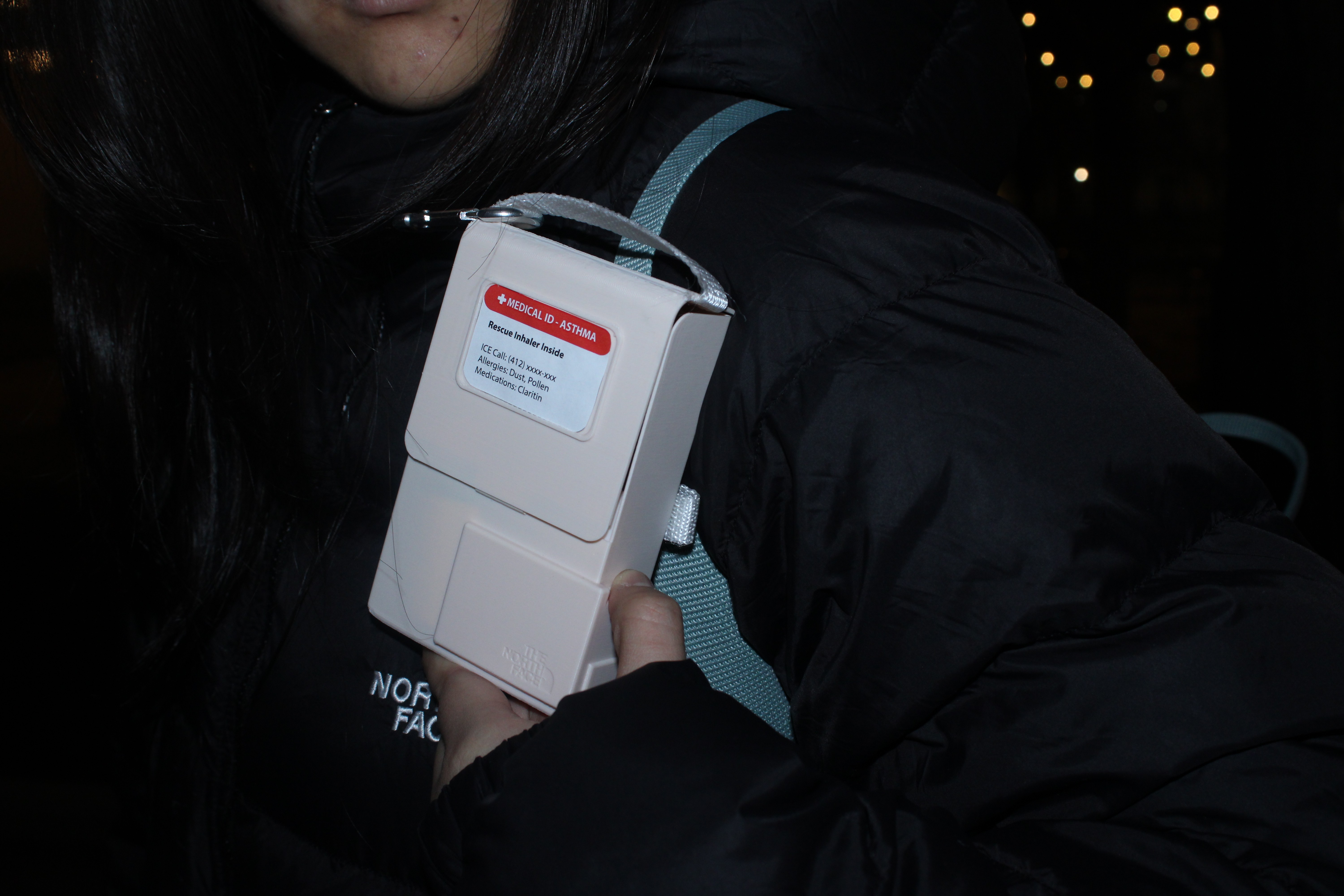

Locate kit

Bystander presses "Instructions" Button

Takes out appropriate Medicines

Helps the Student while the attack
Reflection
Aeris became an exercise in designing not only for the primary user, but for the surrounding network of people who become part of care in an emergency. The project asked how product form, labeling, and sequence can lower the emotional barrier to helping.
The most valuable learning was that assistive objects often need to support multiple levels of confidence at once: the person in distress, the person helping, and the authority figure who arrives later.
Designing for care means making uncertainty easier to move through.